TEF Canada Exam Format
Four sections, all accepted by IRCC for Express Entry, the Canadian Experience Class, and most Provincial Nominee Programs.
| Section | Format | Time |
|---|---|---|
| ReadingCompréhension écrite | 40 multiple-choice questions | 60 minutes |
| ListeningCompréhension orale | 40 multiple-choice questions, audio plays once | ~40 minutes |
| WritingExpression écrite | 2 tasks — Section A: continue a news story; Section B: argumentative text | 60 minutes |
| SpeakingExpression orale | 2 tasks with a live examiner | ~15 minutes |
Format shown reflects the current TEF Canada exam. Always confirm the latest details on your official exam registration portal before test day.
How DeepLingo Prepares You for Each Section
Practice on the real exam format and timing, with instant scoring or detailed AI feedback depending on the skill.
Auto-scored, exam-timed practice sets. Every reading test runs on the real section clock and scores instantly on submission, so you learn to manage your time question by question instead of finding out on exam day.
Auto-scored, single-play audio — just like exam day. Each set scores instantly so you can see exactly which question types (announcements, dialogues, interviews, debates) are costing you points.
Every practice response is graded by AI against the same criteria examiners use: adequacy to the task, coherence, vocabulary range, and grammar — with specific feedback on what to fix next time.
TEF Canada's writing section has two parts: Section A asks you to continue a news story using the facts you're given, and Section B is an argumentative text where you take a position and defend it.
Every recorded response gets AI feedback on the same criteria as writing — adequacy to the task, coherence, vocabulary range, and grammar — broken down per criterion so you know exactly what to work on next.
The real exam is face-to-face with a live examiner across two structured tasks. Practice prompts on DeepLingo are modeled on that same two-task format so the real thing feels familiar.
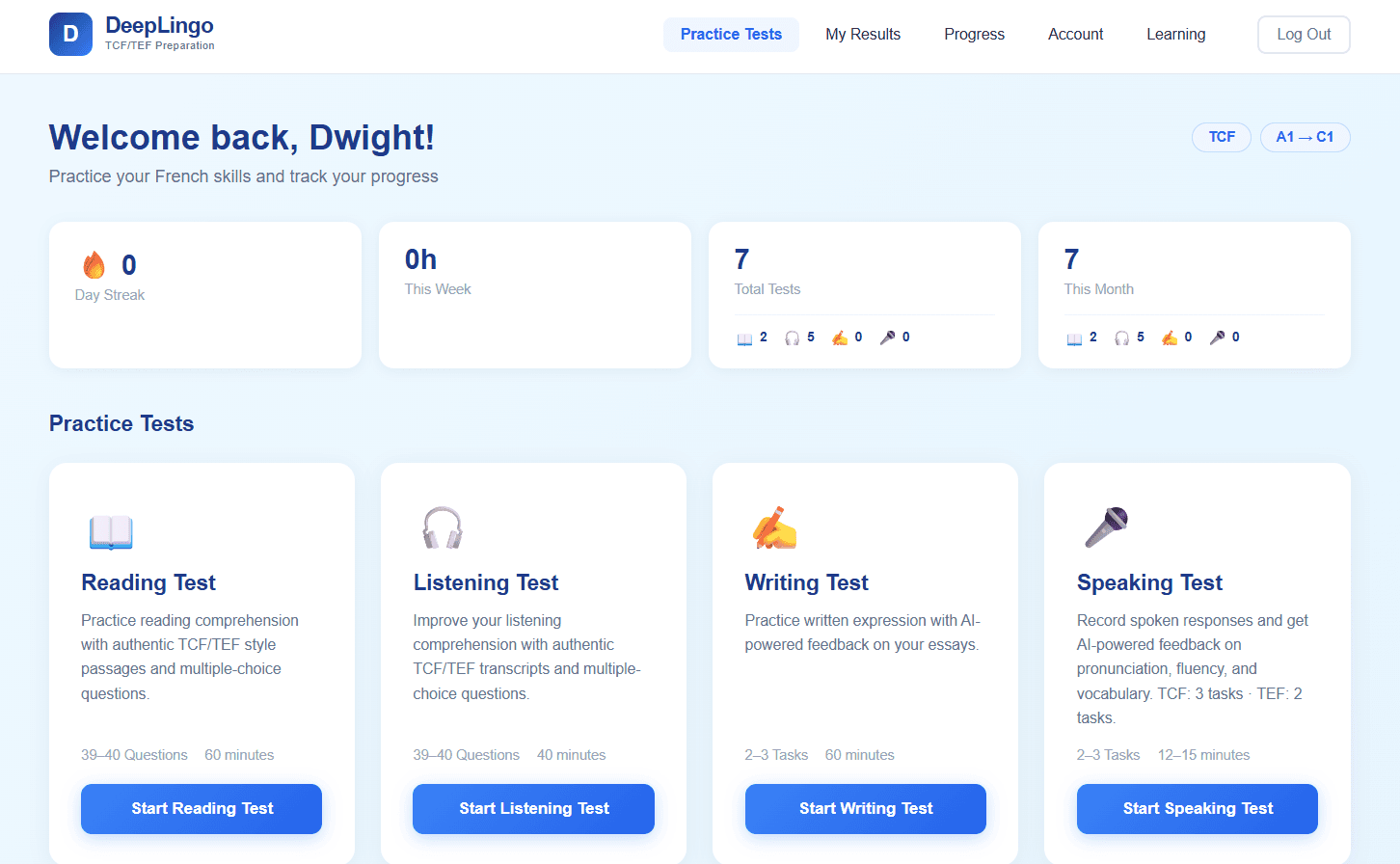
The DeepLingo grading interface — real product, real feedback.
Simple Pricing, Real Practice
Plans from $14.99/month · 3-day free trial · cancel anytime
A single TCF/TEF exam attempt costs $300+. Preparation costs less than a coffee a day.
Every plan also includes the premium features of DeepLingo's Chrome extension — click any French word on YouTube or Netflix subtitles to translate and save it. The basic version is free, no account needed.
- 10 tests per month
- Speaking & writing AI feedback
- All test types
- Browser extension (full features, $6.99/mo value)
- 3-day free trial
- Cancel anytime
- Progress dashboard
- AI tips for reading & listening
- Learning materials
- 20 tests per month
- Speaking & writing AI feedback
- All test types
- Progress dashboard
- Learning materials (A1–C2 courses)
- Browser extension (full features, $6.99/mo value)
- 3-day free trial
- Cancel anytime
- AI tips for reading & listening
- 10 tests/day (unlimited)
- Full AI feedback on all tests
- All test types
- Progress dashboard
- AI tips for reading & listening
- Learning materials (A1–C2 courses)
- Browser extension (full features, $6.99/mo value)
- 3-day free trial
- Cancel anytime
What Our Students Say
Real results from real students preparing for Canadian immigration.
Quotes below are from TCF Canada students — the platform and AI grading engine are identical for TEF.
“I was skeptical at first, but this ended up being way more useful than recording myself and hoping ChatGPT would help. After a few weeks of practice my listening score jumped a whole level.”
“The speaking feedback caught mistakes I didn't even know I was making. Went from B1 to B2 in speaking in about a month. Much better than any app I'd tried before — actually worth it.”
“I needed B2 across the board for my PR application. The writing practice and AI corrections were a game changer — I hit B2 in all four skills on my first attempt.”
“I'm so happy — I got my B1 and was able to renew my work permit through the Francophone Mobility Program. Now my next goal is B2 so I can apply for PR. This platform made it possible.”
“I only needed CLB 5 for my work permit and the platform helped me get there. My employer didn't need an LMIA, so the whole process was fast. Already studying for B2 to get those Express Entry bonus points.”
“My first attempt didn't go well, but after practising with this for a while I improved my score and passed. Would love more practice material for listening, but the speaking feedback is excellent.”
Train your ear between study sessions
The TEF Canada listening section rewards hours of real French audio — so turn Netflix and YouTube time into practice. Click any French word in the subtitles to translate it instantly, hear it pronounced from 55,000+ native-speaker clips, and save it to your vocabulary. Premium features are included with every DeepLingo plan.
- Works on Netflix & YouTube subtitles
- 83,000+ entry French dictionary, offline-first
- Synonyms graded A1–C2, at your level
- Saved words sync to your DeepLingo account